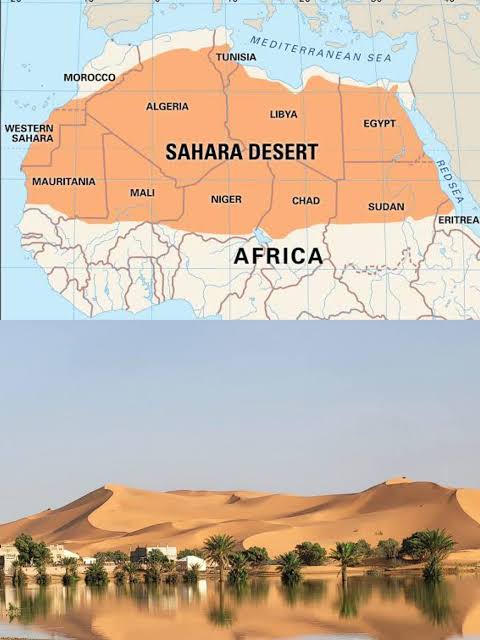
The Sahara is the world’s largest hot desert, covering most of North Africa, known for extreme heat, vast sand dunes, rocky plains, and rare rainfall, yet it hosts diverse life and ancient cultures, having transformed from a green landscape to arid over millennia due to climate cycles, and continues to expand southwards into the Sahel.
Geography & Size
Location: Spans North Africa from the Atlantic Ocean to the Red Sea, bordered by the Mediterranean Sea and the Sahel.
Countries: Includes parts of Algeria, Chad, Egypt, Libya, Mali, Mauritania, Morocco, Niger, Sudan, Tunisia, and Western Sahara.
Area: Approximately 9.2 million sq km (3.6 million sq mi) – nearly the size of China or the USA, making it the world’s largest hot desert (Antarctica and Arctic are larger overall).
Landforms: Features ergs (sand dunes, ~20%), regs (rocky plains), hamadas (barren plateaus), and wadis (dry riverbeds).
Climate & Environment
Temperature Extremes: Extremely hot days (often >40°C) with dramatic drops to near freezing at night.
Rainfall: Very low, with some areas receiving less than 1 inch annually; snow falls in mountain ranges.
Desertification: The Sahara is expanding south into the Sahel, a process influenced by natural climate cycles (like changes in Earth’s orbit) and potentially human factors.
History: It cycles between green, fertile periods (African Humid Periods) and arid desert phases, with the last green era ending around 4200 BCE.
Life & People
Water: The Nile is the only permanent river; underground water reserves exist, supporting oases.
Wildlife: Adapted species include camels, scorpions, snakes, and various adapted reptiles, birds, and mammals.
Inhabitants: Home to diverse peoples like Berbers, Arabs, Egyptians, and Tuareg, with populations concentrated near water sources.
History: Home to ancient civilizations (Kifian, Berber) and trade routes, with evidence of a much greener past.
Key Facts
Name: From Arabic “ṣaḥrāʾ,” meaning “desert”.
Growth: Expanding at about 10 km annually.
Hottest, Not Driest: It’s the hottest, but the Atacama Desert is technically drier.