Five Cent (5c)
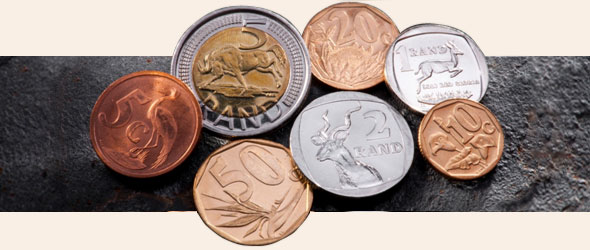
The Blue Crane (Anthropoides Paradisea) is our national bird and is found throughout the large Savannah areas of South Africa, usually near water.Each bird is about 105 cm tall with both sexes identical.
Identification is easy because of the large head with dark brown irises and a pinkish bill. Nesting pairs seem to mate for life and use the same nesting sites.The Blue Crane population is thriving. As the Blue Crane is more-or-less confined to South Africa, it has been used only on South African coins. Our second decimal series.
1965 to 1990, had the Blue Crane on the nickel 5c and it was retained on the copper plated 5c on the third decimal series, but with a redesigned image.
The Blue Crane portrayed on the reverse of the South African 5c was modeled by G Richard; the obverse was modeled by A Sutherland. The design was developed from an original artwork by the well-known artist, Dick Findley. The artwork is on display at the South African Mint’s museum.
50c
The Arum Lily (Zantedeschia Aethiopica) is a distinguished South African flower. It originally appeared on the 50c coin from 1965 to 1989, as part of South Africa’s second decimal series. In 1989 the third decimal coin series was introduced and the Arum Lily was selected for the 10c coin. The design was developed from the original artwork by Cynthna Letty.
The Arum Lily is also known as the white calla lily, aronskelk or varkblom (pig lily). The latter name is due to the fact that the plant’s nutritious rootstock is favoured by pigs and to some extent by porcupines. The plant is also used medicinally in various ways.
The white Arum Lily can be evergreen or deciduous, depending on how much water is gets. The spathe (flower) varies in colour from white to cream and a green and white variation is also found in semi shaded areas
One Rand (R1)
The first Springbok appeared as long ago as 1947 as a true South African symbol on our silver crown size coins. The original design is still viewed as one of the best designs in the world.
Based on the original artwork of one of South Africa’s famous sculptors, Coert Steynberg, the Springbok was used on various other South African coins. These were the gold one-pound and ½ pound coins, and later the gold R1 and R2 coins.
From 1960 to 1964, the Springbok reappeared on the reverse of the 50c. This prancing buck was also chosen to be the symbol on the Krugerrand from 1967 to date. The Springbok was also depicted on the R1 nickel coins from 1977 – 1990. When introducing the current coin series in 1989, the Springbok was once again the chosen design for the reverse of the new smaller R1 coin. The words “SOLI DEO GLORIA” (“To God alone the Glory”) appear on the R1 coins. In 2002, The Johannesburg World Summit (a United Nations Convention) was held in South Africa. To commemorate this prestigious event, a couple of million “World Summit” R1 circulation coins were manufactured and put into circulation.
Two Rand (R2)
As part of the third decimal series, it was agreed that the Kudu be portrayed on South Africa’s first R2 circulation coin. Initially, a leopard design was considered for the R2 but it was decided that designs for the R1, R2 and R5 should be the antelope. The Kudu is known as the “King of the Antelope” because of its magnificent horns
Five Rand (R5)
The Black Wildebeest or Gnu, is portrayed on the reverse of the R5 coin. They are found in the northern grassveld regions of the Cape Province, throughout the Orange Free State to KwaZulu-Natal and the southern regions of Gauteng. Wildebeest hides were at one stage an important commodity in Kwa-Zulu-Natal.Although South Africa’s first decimal coin series was released in 1961, no R5 coins were minted until 1994. In that year, two R5 coins were issued: the reverse of the first commemorated the Presidential Inauguration and that of the second depicted the Gnu (Black Wildebeest). Since 1996, South Africa’s 11 official languages have been acknowledged annually, in rotation, through the representation of the word.
Language rotation
2002 – isiNdebele/ Tshivenda
2003 – Tshivenda/ siSwati
2004 – siSwati/ Xitsonga
2005 – Xitsong/ English
2006 – English/ Setswana
2007 – Setswana/ Sepedi/Sesotho
2008 – Sepedi/Sesotho/ Afrikaans
2009 – Afrikaans/ isiXhosa
2010 – isiXhosa/ isiZulu
2011 – isiZulu/ isiNdebele
Note: The “old” R5 is still a legal tender coin